

Accelerating Discovery: Break Through Cancer’s 2nd Annual Hackathon
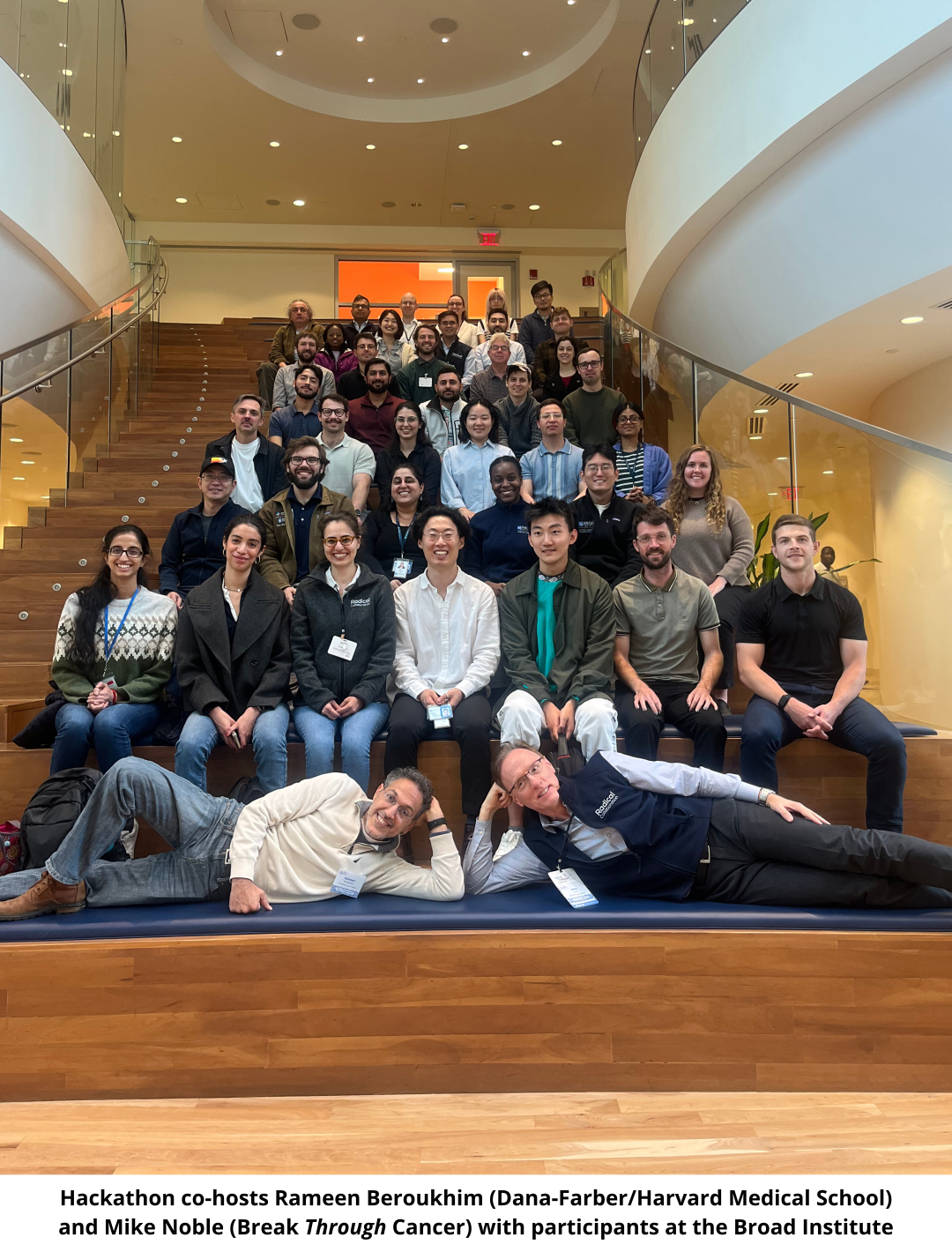
This June, Break Through Cancer hosted its 2nd Annual Hackathon at the Broad Institute, bringing together 67 participants across seven TeamLabs for two days of intense, cross-disciplinary problem solving. Researchers, clinicians, data coordinators, and Break Through Cancer staff worked side by side to tackle some of the most pressing analytical challenges across glioblastoma, ovarian, and pancreatic cancer.
Radical Collaboration in Action
Hackathons are designed to spark innovation by bringing together people who don’t normally sit in the same room. For Break Through Cancer, they are a natural extension of our TeamLab model and an opportunity to accelerate progress by encouraging new collaborations and fresh approaches to complex problems.
Participants worked in small teams on projects ranging from novel ways to align imaging datasets, to new pipelines for integrating genomic and clinical data, to strategies for making Break Through Cancer’s growing data-sharing resources more accessible across labs and institutions.
Spotlight on the Winning Team: Hack2Align
This year’s winning team, Hack2Align, combined the CODA/PIVOT tools (developed in association with the Demystifying Pancreatic Cancer TeamLab), four cancer imaging datasets contributed by the Accelerating GBM Therapies Through Serial Biopsy TeamLab (H&E, Xenium, MALDI, and CyCIF/ImF), and the analytical expertise of the Data Science TeamLab. Together, they built a prototype workflow for analysis across imaging modalities, a critical step toward integrating multimodal data at scale.
Despite being an early-stage prototype, their pipeline achieved a remarkably robust alignment, demonstrating proof-of-concept for a system that could one day enable comprehensive multimodal analyses of spatially resolved cancer datasets across TeamLabs.
What does this mean? Tools like this could allow our TeamLabs bring to more quickly integrate and better analyze imaging, genomic, and clinical data. For example, in glioblastoma, aligning multiple imaging types could help pinpoint how tumors change over time. In ovarian cancer, it could help connect tissue patterns with genetic signatures of resistance. By making different datasets “talk” to each other, Hack2Align’s approach lays the groundwork for sharper insights and ultimately better options for patients.
More Than a Competition
While Hack2Align earned top recognition, the real success of the Hackathon was the spirit of teamwork. Across projects, participants reported learning new skills, forging new collaborations, and leaving with ideas that could be carried forward into their TeamLab research.
“This Hackathon is radical collaboration in action,” said Michael Noble, Chief Data Officer at Break Through Cancer. “By putting biologists, clinicians, data scientists, and engineers shoulder-to-shoulder, we can prototype solutions to problems that have slowed the field for years. These two days weren’t just about coding. They were about fostering interaction, unlocking new ways of aligning complex data, sharing insights across cancers, and building tools that will carry forward into our TeamLabs. That’s the radical collaboration our model is designed to spark.”
Looking Ahead
The Hackathon has become a highlight of the Break Through Cancer calendar year and a chance to connect people, ideas, and technologies in service of faster progress for patients. We’re already looking forward to seeing how these collaborations evolve and what insights next year’s Hackathon will spark.
BE PART OF THE MISSION
Stay Informed, Make an Impact
Subscribe
Be the first to hear about cutting-edge research, pioneering projects, and the latest advancements in Break Through Cancer science. Sign up to stay informed.
Give
Your contribution fuels groundbreaking research in some of the most challenging cancers. Every gift accelerates progress. For more information please contact Michaela Forand at MF@breakthroughcancer.org or 1-800-757-9881 ext 2.

